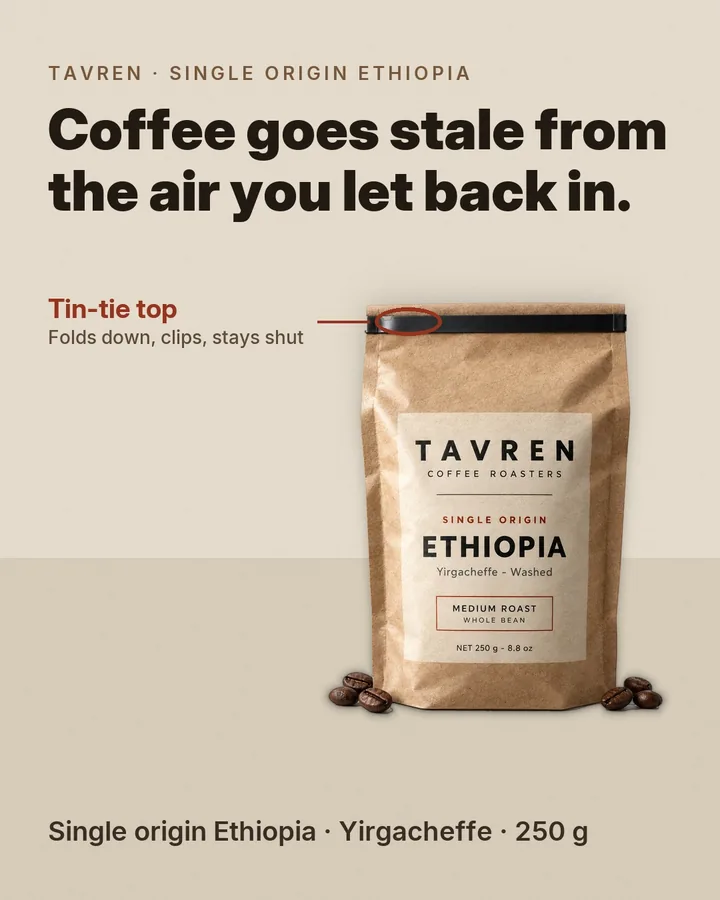
One person, one problem
An ad is read quickly, in a feed full of other things. The ones that stop a thumb are usually about one problem a particular person has, said in the words that person uses. A general ad for everyone speaks to no one. So we start with the objection: what stops this buyer from buying today. The offer answers it, the proof backs it, and the visual makes the line unmissable.
The sample on this page is a demo, not a client. It starts from one objection, coffee going stale, and offers one answer, a tin-tie top. Everything else is design to carry that line. We do the same for your product, from your pack and your proof.
To spec, every time
Each platform asks for specific sizes, safe zones for text and file limits, and they change. A good-looking ad that has its headline under a button is a bad ad. We build to the published specs, check each export and name every file clearly so your team knows what goes where. The same discipline applies to marketplace images, covered in more detail on the Amazon listing images page.
Claims are checked too. A line that overstates what the product does can get an ad rejected or an account restricted, and it can mislead a buyer. We check every line against your pack and your proof before it goes out.
Creative as a test, not a verdict
No one can say in advance which ad will perform. What we can do is give you distinct ideas, rather than one idea repeated, so a test teaches you something. The results are read in your account, through Meta or Google, in the platform's own numbers, and the next round is built from what you saw.
Where the right format is motion, we make short product videos from your photographs. See AI product videos. For landing pages that carry the same message, see website development. Prices are not printed here. Every quote is fixed and in writing within one working day.
One more thought on volume. More creatives is not automatically better. Twelve ads that are the same idea in different colours teach you less than three that are really different. So we agree the concepts first, and only then the sizes and the variants. When the account has results, the next round starts from what you saw, and the brief gets shorter and sharper each time.