Why small tools
Most businesses have a task that someone does by hand every week: copying numbers between sheets, resizing images, checking a list against another list, building a report. The task is too small for a software project and too repetitive to keep doing by hand. A small, single-purpose tool is the right size for it. It does one job, it can be checked in minutes and it costs far less than a platform subscription.
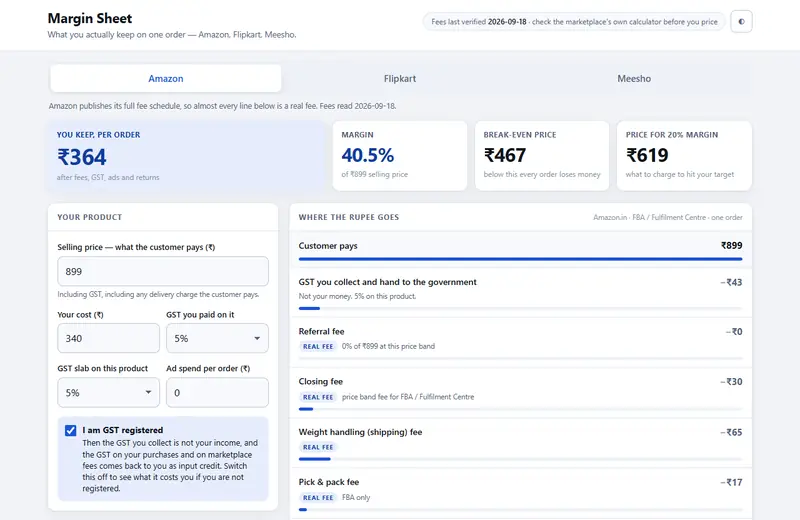
That is the pattern behind the tools on this site. Our tools page lists the ones we built for our own Amazon work, such as the margin sheet and the A+ builder. They run in your browser and send nothing to us. They are free because they started as our own working tools.
The spec is the project
The most valuable hour is the first. We ask what goes in, what comes out and what the tool must never do, and write it down. A tool that never corrupts a file, never sends data anywhere and never silently drops a row is a better tool than a clever one. You approve the spec, and the build follows it.
Then we show a working version early. A first version that does most of the job is more useful for steering than a polished one that does the wrong thing. We test with your sample data and your edge cases, and we write down how to use the tool in plain words.
Owning it
You receive the tool as files. There is no account to keep paying and no service we can turn off. If it runs in the browser, it works from a file on your machine, and your data stays there. If it needs a server, we say so before we start, and the hosting is paid by you to the provider.
Tools often sit next to other work. A margin sheet is a pricing tool. A stock compare is inventory work. A calculator can sit on a website and bring in enquiries. We promise the spec, the build and thirty days of fixes. We do not promise a saving, because it depends on how you use the tool.
A last note on maintenance. Small tools last when they are simple and when their assumptions are written down. Each tool we build comes with a short plain-text note saying what it expects, what it does and what to check if its output looks wrong. If a website or a file format that the tool relies on changes, the note tells your team where to look, and we can help with a quoted fix.